



You’ve invested in SEO. You’re running Google Ads. Guests are finding your hotel online, but the bookings aren’t coming in at the rate you’d expect. Sound familiar?
This is one of the most common frustrations for independent hotels and restaurants in Thailand and across Southeast Asia. The traffic is there. The interest exists. But something in the journey from discovery to confirmation is quietly losing you revenue.
The missing piece is often a weak direct booking architecture: the structured system of website elements, booking flows, and trust signals that work together to move a visitor from interest to confirmed reservation. At the centre of that architecture is hotel CRO, or Conversion Rate Optimization. While most hospitality marketing conversations focus on getting more visitors, hotel CRO is about making sure those visitors actually book. The average hotel website converts just 2.5 to 3.5 % of visitors into guests. Top-performing hotels achieve 5 % or higher. That gap, closed without spending a single extra baht on advertising, is the promise of hotel CRO.
In this guide, we break down six high-impact hotel CRO strategies that boutique hotels and restaurants can implement to stop leaving revenue on the table.
What Is Hotel CRO and Why Does It Matter?
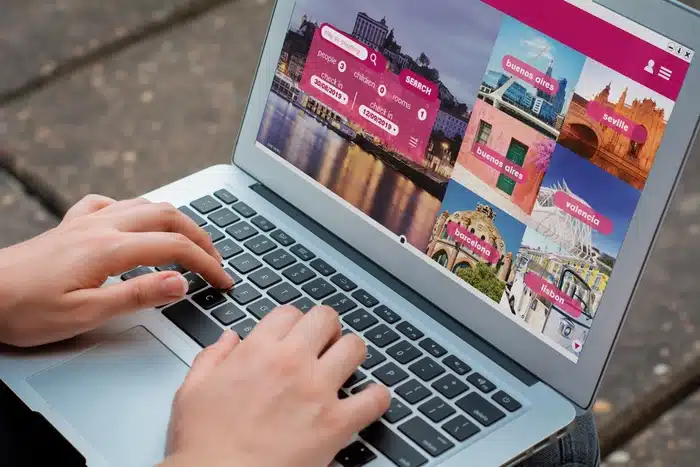
Hotel CRO (Conversion Rate Optimization) is the process of improving your website so that a higher percentage of visitors complete a direct booking or reservation.
Here’s why it matters: every visitor who lands on your website and leaves without booking represents lost revenue you’ve already paid to attract. Whether that visitor came from SEO, Google Ads, Instagram, or a TripAdvisor listing, you’ve invested in bringing them to your door. Hotel CRO is how you stop them leaving before they book.
Hotels that treat CRO as a core pillar of their direct booking architecture routinely see conversion improvements of 10 to 20 % within 90 days, without increasing ad spend.
Strategy 1: Build a Mobile-First Experience
Nearly 70% of hotel bookings now happen on mobile devices. If your website isn’t designed with mobile as the primary experience, you’re losing the majority of your potential guests before they’ve seen a single room.
A mobile-first hotel website means more than a responsive layout. It means large, tap-friendly booking buttons, a booking engine that works flawlessly on a smartphone screen, fast-loading images, and a checkout process that doesn’t require pinching and zooming. Walk through your own website on a mobile device right now and ask honestly: would you complete a booking here? That test alone often reveals the most critical fixes.
| Quick Win: Test your website on a real smartphone, not just browser dev tools, and time how long it takes to reach the booking confirmation screen. If it takes more than 3 taps and 3 minutes, your mobile flow needs work. |
Strategy 2: Make Page Speed a Priority
Page speed is not a technical nicety. It is a revenue issue. When your website takes more than three seconds to load, you have already lost approximately half your visitors. On mobile connections, which are common across Thailand and Southeast Asia, even a two-second delay can increase bounce rates significantly.
The most common causes are oversized image files, unoptimized video backgrounds, and bloated page builders. The most direct fixes are image compression, lazy loading, and upgrading to a faster hosting plan. Google PageSpeed Insights gives you a free audit in minutes and shows exactly which fixes will have the biggest impact on your specific site.
Strategy 3: Optimize Your Booking Engine Experience
Your booking engine is where revenue is either made or lost. Even if every other part of your website performs well, a slow, confusing, or visually inconsistent booking engine will kill your conversion rate at the final hurdle.
High-converting hotel booking engines share a few key characteristics. They load quickly and match the visual style of the main website, because jarring transitions to a third-party system erode trust. They offer a simple, linear flow: choose dates, choose room, confirm details, pay. They display clear room names and compelling photography inside the engine itself, not just on the main site. And critically, they do not ask guests to create an account before completing a purchase. Every added step is a reason to leave.
If your current booking engine cannot deliver these fundamentals, the SEO and advertising investment you make is partially wasted every single day.
Strategy 4: Use Price Transparency to Beat OTA Fear
One of the biggest reasons guests abandon a direct booking and return to Booking.com or Agoda is the fear of missing a better deal. This is a perception problem, and it is one your direct booking architecture can solve.
The most effective approach is a Best Rate Guarantee, displayed prominently at the point of booking. Pair this with messaging that shows your direct price alongside the OTA equivalent. When guests can see that booking directly costs the same or less, and comes with added benefits like free early check-in or flexible cancellation, the hesitation disappears.
Guests don’t return to OTAs because they prefer them. They return because your website hasn’t given them a compelling enough reason to stay.
| Stat to know: Research from Cornell University found that 75% of guests who booked directly had visited an OTA first. That means they were already considering your hotel, your website just needed to close the deal. |
Strategy 5: Build Trust With Visuals and Social Proof
For hospitality businesses, trust is the conversion trigger. Guests are making a financial commitment to a place they haven’t physically visited, and every element of your website either increases or decreases their confidence in that decision.
High-quality photography is non-negotiable, but video now plays an equally important role. Research shows that video content on a hotel website can increase conversion rates by up to 80%. A 60-second walkthrough of your rooms and spaces creates an emotional connection that no static image can replicate.
Beyond visuals, social proof is critical. Displaying real guest reviews directly on your website, not just linking to TripAdvisor, keeps potential guests engaged in your ecosystem. Certificates of excellence, sustainability awards, and press recognition also serve as trust signals that move hesitant visitors toward the book button.
Strategy 6: Streamline the Path to Booking
Every unnecessary page, form field, or decision point between a visitor and a completed booking is a potential exit. Hotel CRO applies one question to every element of your website: does this help guests book, or does it distract them?
Practically, this means placing your booking widget on every key page, not just the homepage. It means ensuring your Rooms page links directly into the booking engine for each room type. It means using exit-intent prompts for visitors who are about to leave, offering a small incentive such as complimentary breakfast or flexible check-in time. And it means making your phone number and LINE contact immediately visible, because a phone booking is still a direct booking.
How Hotel CRO Powers Your Direct Booking Architecture

Hotel CRO doesn’t exist in isolation. It is the final layer of a direct booking architecture that determines whether your wider marketing investment pays off. Consider what happens when you improve your website’s conversion rate from 2.5 % to 4 % without changing your advertising budget. Every baht you spend on Google Ads now generates more bookings. Every visitor who arrives from SEO has a higher probability of converting. Your Google Hotel Ads campaigns become more profitable because the traffic they deliver lands on a page built to close.
This is why a strong direct booking architecture is not optional for hotels and restaurants investing in digital marketing. Better SEO without hotel CRO is like driving guests to a restaurant with no seating. Better ads without hotel CRO is paying for footfall through a broken door.
For properties already investing in SEO, paid advertising, or reputation management, hotel CRO is typically the fastest path to improved returns from existing investment, and often requires no additional media spend to deliver measurable revenue impact.
The Guests Are Already There, Convert Them
The most important insight from hotel CRO is that you don’t always need more traffic to grow your direct booking revenue. Sometimes, you simply need to stop losing the traffic you already have. A direct booking architecture that converts at 5 % instead of 2.5 % doubles your bookings with the same SEO, the same ad spend, and the same audience.
Speed, mobile experience, booking engine UX, price transparency, trust signals, and a streamlined path to booking: these six strategies form the foundation of a direct booking architecture that works. None of them require a full website rebuild. All of them can be addressed incrementally, with measurable results at every step.
Ready to audit your hotel’s conversion rate and identify where you’re losing guests? Contact the BFound Digital team to get started.
Ready to Turn More Visitors into Guests?
BFound Digital helps hotels and restaurants across Thailand and Southeast Asia optimize their websites for higher direct bookings. Book a free consultation with our team today.
Follow us for tips, insights, and strategies that actually work for your business.
🌐 Website: bfound-digital.com
📘 Facebook: BFound Digital
📸 Instagram: @bfounddigital
▶️ YouTube: BFound Digital
💼 LinkedIn: BFound Digital
🎵 TikTok: @bfounddigital