


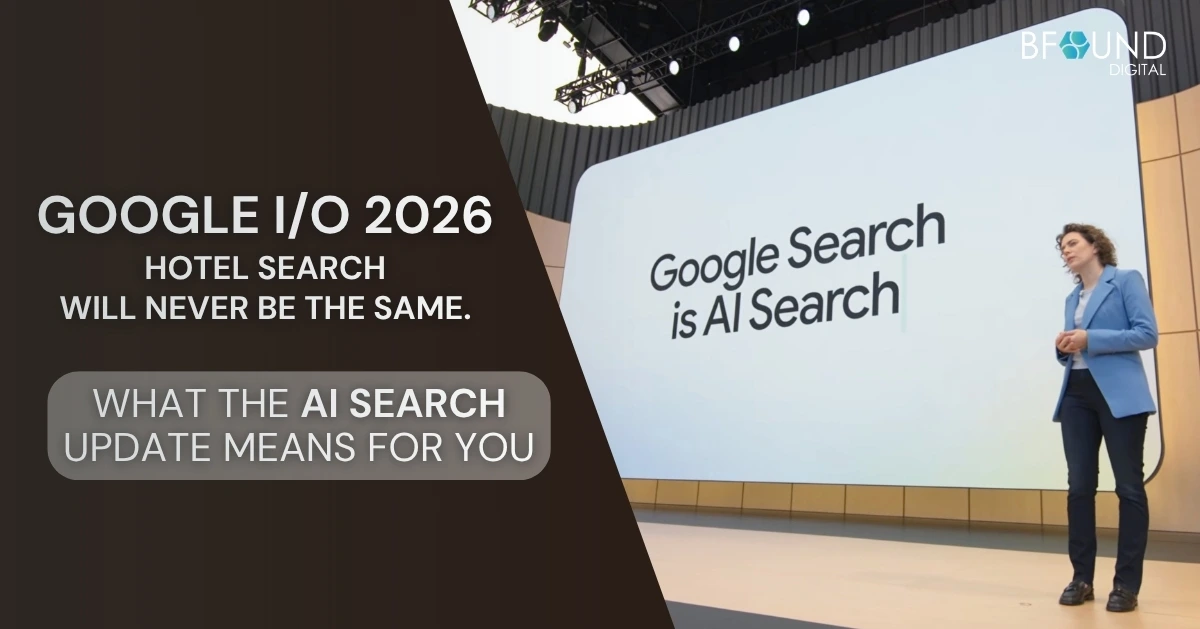
Google just announced the biggest upgrade to its Search product in over 25 years. At Google I/O 2026, the company revealed that AI Mode, its AI-powered search experience, has surpassed one billion monthly users, with queries more than doubling every quarter since launch. For hotels and restaurants across Thailand and Asia-Pacific, this is not a technology story to file away for later. It is a direct signal that Google AI search hotel marketing has fundamentally changed, and the properties that understand these changes first will have a clear competitive advantage.
Here is what was announced, what it means in practice, and what your property should do about it.
What Google Announced at I/O 2026
Google’s I/O 2026 keynote introduced four major changes to Search that are already rolling out globally. Gemini 3.5 Flash is now the default AI model powering AI Mode for all users worldwide, delivering faster and more capable responses than previous versions. A new intelligent Search box, redesigned for the first time in 25 years, now expands dynamically, supports text, images, files, videos, and browser tabs as inputs, and offers AI-powered suggestions that go beyond simple autocomplete.
Two other announcements carry even more weight for hospitality businesses. Search agents are autonomous AI agents that operate in the background, continuously monitoring the web on a user’s behalf. And agentic booking now allows Google to surface real-time pricing, availability, and direct booking links for hotels, local experiences, and services, with the ability to call businesses directly for certain categories.
Each of these changes affects where and how your property appears to potential guests.
AI Mode Is Mainstream and Your Guests Are Already Using It
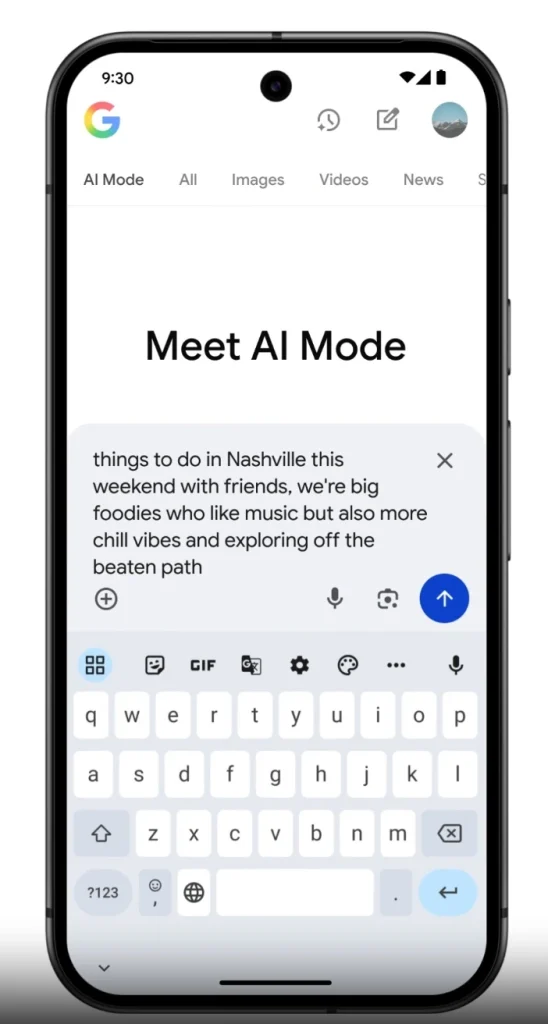
The scale of adoption matters as much as the technology itself. One billion monthly users in AI Mode is not a pilot program or an early-adopter trend. It is the primary search experience for a significant and growing share of global travelers.
When a guest searches for where to stay in Phuket, the best restaurant in Chiang Mai’s old city, or a boutique hotel near Bangkok’s riverside, they are increasingly seeing AI Overviews, synthesized summaries at the top of results that pull from websites Google trusts. Google AI Mode hotels is the experience your future guests are already having, whether your property is ready for it or not.
AI Overviews favor well-structured, clearly written content on technically sound websites. If your property’s website lacks relevant keywords, has slow load times, or is missing structured information about room types, location, and amenities, you are unlikely to appear in these AI-generated summaries. A competitor who has invested in SEO will be the property guests read about first.
Search Agents: Google Is Now Watching the Web on Your Guests’ Behalf
The most significant change announced at I/O 2026 is Search agents. These are autonomous AI agents that run continuously in the background, monitoring the web around the clock on behalf of the user. A guest planning a trip to Thailand can instruct a Search agent to track hotel availability, watch for price changes, monitor new reviews for specific properties, or alert them when a particular type of accommodation becomes available in a given area.
The agent synthesizes findings and sends intelligent updates, without the guest ever having to search again manually.
In practice, this means your property’s review profile, pricing consistency, listing accuracy, and response rate to guest feedback are now under continuous, automated scrutiny from potential guests who have not yet visited your page. A cluster of unanswered negative reviews, a stale Google Business Profile, or inconsistent OTA pricing will be surfaced by an agent and influence a booking decision before the guest has actively engaged with your listing.
Reputation management is no longer a task to handle when you have time. Your online presence needs to be accurate and strong at all times, because agents are watching it continuously.
Agentic Booking Changes How Guests Find and Choose Where to Eat and Stay
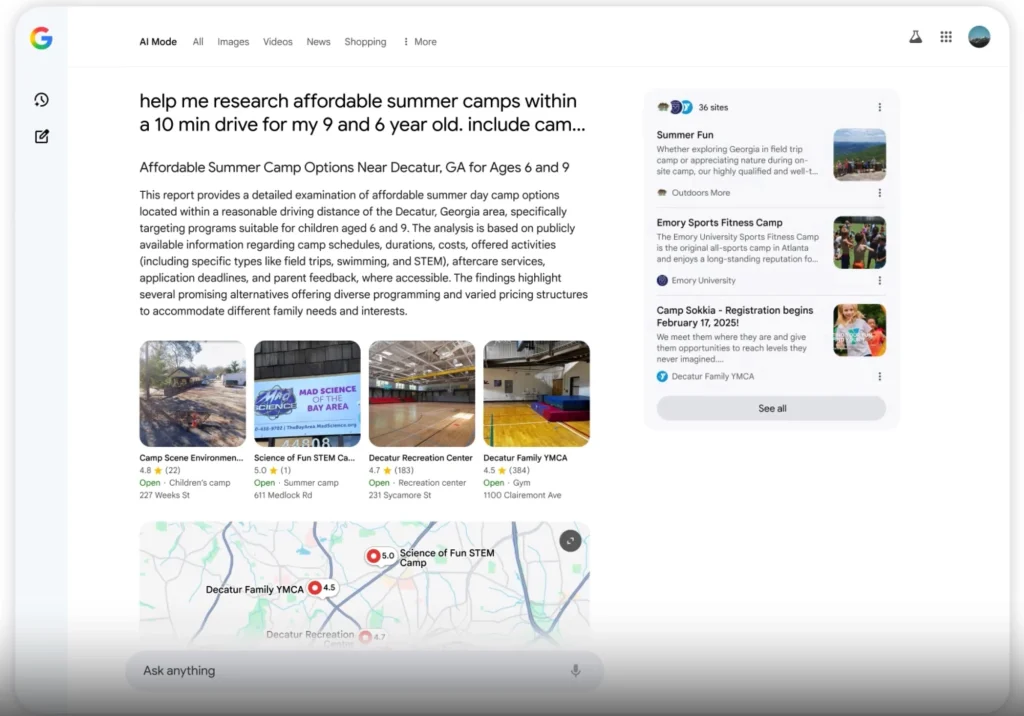
Google’s agentic booking feature allows a user to describe exactly what they are looking for and have Google do the comparison work. A guest can ask for a boutique hotel with a pool in Chiang Mai for two nights under a certain budget, and Google’s agent will surface matching options with real-time pricing, availability, and direct booking links. For restaurants, a user can specify a private dining room for six on a Friday evening that serves food late, and Google will return relevant results with reservation links.
This is a major shift in how AI search updates restaurant and hotel discovery work. Instead of a guest browsing through multiple OTA pages, comparing listings manually, and navigating between booking platforms, an AI agent now does that work for them and delivers curated, actionable results.
For your property to be included in agentic results, your online inventory needs to be accurate and current across all channels. Your website must communicate room types, pricing, and availability in a structured, readable format. And your direct booking page needs to be fast and frictionless, because Google’s agent may link directly to it, and a slow or confusing booking process will cost you that guest at the final step.
Google has also announced that for select service categories, it can call businesses directly on the user’s behalf to check availability.
For restaurants specifically, this makes having accurate contact details, up-to-date hours, and a clear reservation process on your Google Business Profile more important than it has ever been.
Personal Intelligence: Search Is Now Personalized to Each Guest
Google is also expanding Personal Intelligence globally, a feature that allows AI Mode to connect with a user’s Gmail, Google Photos, and soon Google Calendar to deliver personalized search results. When a guest searches for a hotel or restaurant, Google can factor in their past travel patterns, booking history inferred from emails, loyalty memberships, and upcoming calendar commitments.
This changes the competitive landscape in a subtle but important way. A guest who has received promotional emails from a competing property, or who has a confirmed booking at a nearby hotel in their Gmail, will see a different set of AI-generated recommendations than a guest with no prior travel email history. Properties with strong direct booking relationships, active email communication with past guests, and consistent Google Business Profile engagement have a natural advantage in a personalized AI search environment.
For hotels and restaurants that have no email presence, no returning guest communication, and minimal Google Business activity, Personal Intelligence widens the gap between them and more digitally active competitors.
What Hotels and Restaurants Should Do Right Now
The Google I/O 2026 announcements confirm what hospitality businesses with strong digital strategies have already seen in their results: investing in SEO and Google presence is not a nice-to-have. It is the mechanism by which AI-powered search decides who appears and who does not.
Strong SEO is the foundation. AI Overviews, Search agents, and agentic booking all draw from websites that Google’s systems trust. That trust is built through well-structured content, relevant keywords, fast load speeds, and technically sound websites. Properties without this in place will not appear in AI-generated results, regardless of how good the product is.
Your Google Business Profile needs to be complete, current, and actively managed. This is the single most visible data source Google uses when surfacing hotels and restaurants in AI responses, local maps, and agentic booking results. Outdated hours, missing photos, unanswered reviews, and incomplete menus or room descriptions are now more costly than they have ever been, because they affect not just human visitors but also the agents running on their behalf.
Your website must support direct bookings clearly. Agentic booking flows send users directly to booking links. If your booking page is buried, slow, or unclear, you will lose guests that Google has already sent your way.
And for restaurants specifically: make sure your Google Business Profile includes accurate reservation options, current menus, and responsive review management. These are the signals that agentic search draws from when deciding which dining options to surface for a guest who is ready to book.
Is Your Property Ready for AI Search?
At BFound Digital, we help hotels and restaurants across Thailand build the kind of digital presence that performs in the new era of AI-powered search. From SEO and Google Business Profile management to website optimization and direct booking strategy, we make sure your property is visible and competitive wherever your guests are searching.
Contact the BFound Digital team today and find out where your property stands in the new AI search landscape.
Follow us for tips, insights, and strategies that actually work for your business.
🌐 Website: bfound-digital.com
📘 Facebook: BFound Digital
📸 Instagram: @bfounddigital
▶️ YouTube: BFound Digital
💼 LinkedIn: BFound Digital
🎵 TikTok: @bfounddigital