



The Thailand hotel industry in 2027 is heading into a year where revenue still grows, but very little else does. That is the picture from Kasikorn Research Center (KResearch), whose 26 October 2026 analysis puts accommodation revenue for 2026 at around THB 1.1 trillion while business closures climb and room supply keeps running ahead of demand.
Key takeaways
- Revenue grows, profit does not. Sector revenue is forecast at around THB 1.1 trillion in 2026, up 2.6%, but about 51% of operators still lost money in 2025.
- Occupancy stays flat in 2027. The national rate is projected at 69.58% to 71.69%, with foreign arrivals of 31 to 33 million, still below 2019.
- Oversupply is the real pressure. Room stock is 11.7% above 2019 while overnight guests per room have fallen from 249 to 228, which is pushing rates down.
- Closures are accelerating. Hotel and accommodation deregistrations rose 42% year on year in the first nine months of 2026, hitting small operators hardest.
For owners and marketing teams, the detail matters more than the headline. Here is what the numbers say, and what we think hotels should do about them.
Where the market stands going into 2027
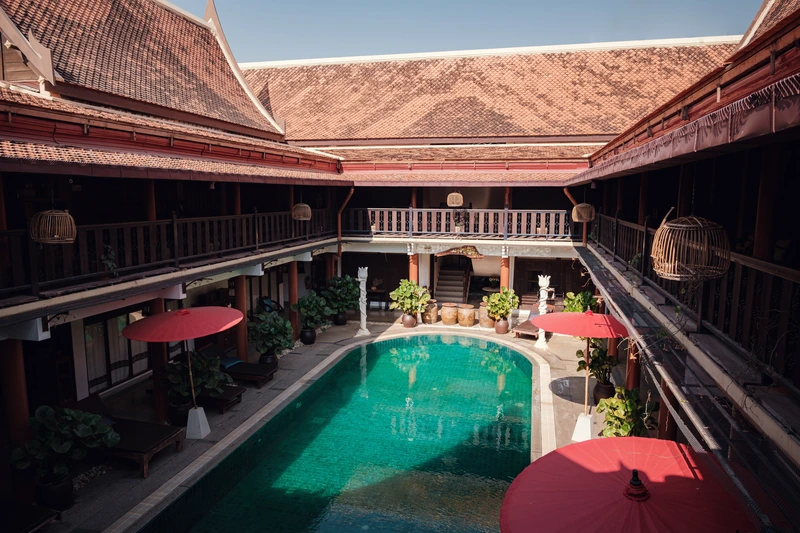
KResearch estimates 2026 revenue for hotels and accommodation at roughly THB 1.1 trillion, up 2.6% on 2025. Room revenue accounts for about 77% of that, with the remaining 23% coming from banqueting, meetings, and food and beverage.
The sector carries real economic weight. It represents around 5.7% of GDP at current 2026 prices, covers about 15,000 registered operators, and employs roughly 430,000 people.
More than 98% of those operators are small or medium-sized, which is exactly where the pressure is landing. In the first nine months of 2026, 148 accommodation businesses were deregistered, a 42% increase year on year, while new registrations fell 31.2% to 779.
The profitability data is sharper still. In 2025 around 51% of operators recorded a loss, and 38% had posted accumulated losses for three consecutive years from 2023 to 2025. Among small operators the loss rate reached about 54%.
Thailand hotel occupancy rate: what 2027 looks like
Occupancy in the first nine months of 2026 grew just 0.18% year on year, and 19 provinces went backwards. The national average held up, but the recovery was not evenly spread.
For 2027, KResearch forecasts a nationwide occupancy rate of 69.58% to 71.69%, a range that runs from a 2% contraction to 1% growth. That follows a 0.1% decline in 2026.
International arrivals sit behind that number. Thailand is expected to receive about 31.4 million foreign visitors in 2026, down 4% and only 79% of the 2019 level, with 2027 projected at 31 to 33 million.
Domestic travel offers a little more stability, forecast at 205.5 to 208.0 million trips in 2027. KResearch flags long-haul markets in Europe and the Middle East as the ones to watch, since those guests stay longer than short-haul visitors.
Room oversupply is the structural problem
Thailand had about 876,000 hotel rooms in the first half of 2026, up 3.4% on the end of 2025 and 11.7% above 2019. Rooms increased in 64 provinces.
Demand has not kept pace. Overnight tourists per available room fell from 249 in 2019 to 228 in 2026, and 20 provinces now have more rooms than they did in 2019 while overnight guest numbers remain below 2019 levels, among them Phuket, Chiang Mai, Songkhla, Rayong and Khon Kaen.
Short-term rentals add another layer. AirDNA data from October 2026 counts roughly 50,000 listings across Bangkok, Phuket, Chonburi, Chiang Mai and Surat Thani, equal to about 10% of registered room stock in those provinces. Those listings ran at 60% average occupancy over the preceding twelve months.
The predictable result is discounting. The national average daily rate (ADR) is expected to fall around 0.8% in 2026, after growing only 0.1% in 2025.
Costs and regulation tighten at the same time
Variable costs make up roughly 40% to 45% of total costs for most properties, and KResearch expects them to rise in 2027. Energy prices feed into electricity, food transport and hotel supplies, while OTA platform fees push marketing costs up from the other side. Because hotels also carry high fixed costs, softer occupancy and higher variable costs squeeze margins from both ends. Operators with limited liquidity are the ones most likely to close.
Regulation is moving too. The draft Accommodation Act, which would replace the Hotel Act of 2004, is under review by the Council of State and would extend oversight to homestays, hostels, boutique hotels and sharing-economy stays, with a Super License to reduce duplicated paperwork.
Sustainability rules are already live in a key market. The EU’s green transition consumer law took effect on 27 September 2026 and requires sustainability claims and labels used in OTA listings to be backed by credible certification and verifiable data.
What hotels should do now
The research describes the market. This part is our read on what it means for marketing and revenue decisions over the next twelve months.
Stop defending occupancy with price
With ADR already falling nationally, discounting into an oversupplied market mostly transfers margin to the guest. Building value through packages, ancillary revenue and longer stays protects the rate far better than a lower nightly price.
Move volume off the OTAs
OTA commission is a variable cost that rises exactly when you need it to fall. Growing the share of bookings that come directly through your own website is the most controllable lever most properties have on their cost base.
Diversify your source markets
With 18 major source markets still below 2019 levels, a property built around one or two nationalities carries real concentration risk. Multilingual content and market-specific campaigns spread that risk before it becomes a revenue problem.
Go after MICE and wellness demand
KResearch points to government policy favouring MICE and wellness tourism under the Visitor Economy approach. These segments carry higher spend per guest and are far less price-sensitive than transient leisure guests, and they need dedicated pages and content to be found at all.
Make sure AI search can find you
Travellers increasingly research destinations through AI assistants and AI Overviews before they ever reach a booking site. Keeping up with current hotel marketing trends and structuring your content so answer engines can read it is becoming a visibility requirement, not an experiment.
None of this removes the macro pressure KResearch describes. What it does decide is which properties absorb that pressure and which ones do not.
If you want a view on where your own property sits, our hotel digital marketing consultants can walk through your channel mix and search visibility with you.
Source: Kasikorn Research Center (ศูนย์วิจัยกสิกรไทย), Econ Digest, 26 October 2026. Read the original analysis.
Frequently Asked Questions
What is the forecast for the Thailand hotel industry in 2027?
KResearch expects 2027 to stay fragile rather than recover. Foreign arrivals are projected at 31 to 33 million, a range running from a 1% contraction to 5% growth, while domestic travel is forecast at 205.5 to 208.0 million trips. Nationwide occupancy is expected to land between 69.58% and 71.69%. Revenue may still grow, but rising variable costs and heavy discounting mean profitability is the real question for 2027, not top-line revenue.
Why are hotels closing in Thailand?
Closures are rising because supply has grown faster than demand. In the first nine months of 2026, deregistrations of hotel and accommodation businesses rose 42% year on year to 148 companies. KResearch attributes this to two forces: international arrivals that have not returned to 2019 levels, and room supply that has expanded 11.7% above 2019 while overnight guests per room fell from 249 to 228. Small operators are hit hardest, with around 54% recording a loss in 2025.
What is the hotel occupancy rate in Thailand?
Thailand’s nationwide occupancy is forecast at 69.58% to 71.69% in 2027, following near-flat growth of 0.18% in the first nine months of 2026. The national average hides wide variation: 19 provinces recorded negative occupancy growth during that period. Properties in provinces where room supply has grown but overnight visitor numbers remain below 2019, including Phuket, Chiang Mai, Songkhla, Rayong and Khon Kaen, are facing tougher conditions than the national figure suggests.
Is there an oversupply of hotel rooms in Thailand?
Yes, by most measures. Thailand had around 876,000 hotel rooms in the first half of 2026, up 3.4% on the end of 2025 and 11.7% above 2019, with increases recorded in 64 provinces. Over the same period, overnight tourists per available room fell from 249 in 2019 to 228 in 2026. Short-term rentals add roughly 50,000 more units across five major tourist provinces, equal to about 10% of registered room stock there.
How can hotels reduce their OTA commission costs?
The most durable approach is growing direct bookings so fewer reservations carry commission at all. That usually means a fast booking-ready website, strong organic visibility for your property name and location, an active Google Business Profile, and metasearch presence so your own rate appears alongside OTA listings. It is slower than buying OTA visibility, but it lowers a cost that scales with every booking, which matters more when occupancy is flat and rates are under pressure.
What marketing should Thai hotels prioritise in 2027?
Prioritise the channels you own. With ADR falling nationally and variable costs rising, discounting gives away margin you cannot recover, so the stronger plays are direct booking growth, source-market diversification, and content aimed at higher-spend segments such as MICE and wellness travellers. Visibility in AI search is now part of that too, since many travellers research through AI assistants before reaching a booking site. Sustainability certification also matters for European demand following the EU rules effective 27 September 2026.