



When was the last time a potential guest typed “best hotel in Bangkok” into Google and actually clicked through to page two of the results? Probably never. But here’s a far bigger shift happening right now: more and more travelers are not even opening Google at all. They’re asking ChatGPT, Google’s AI Overviews, and Perplexity to plan their entire trip, hotels, restaurants, activities, and all.
According to Gartner, traditional search engine use is expected to drop by 25% by 2026 as AI-powered search takes over. A 2026 TravelBoom study revealed that 83% of travelers have already used or are interested in using AI tools to help plan their trips. That means the rules of digital visibility have fundamentally changed, and if your hotel or restaurant is not yet optimized for AI search, you are missing a rapidly growing stream of high-intent guests.
Enter Generative Engine Optimization, or GEO. It may well be the most important shift in hospitality marketing you have not yet heard of, and the brands that move now will own the next decade of visibility.
What Is Generative Engine Optimization (GEO)?
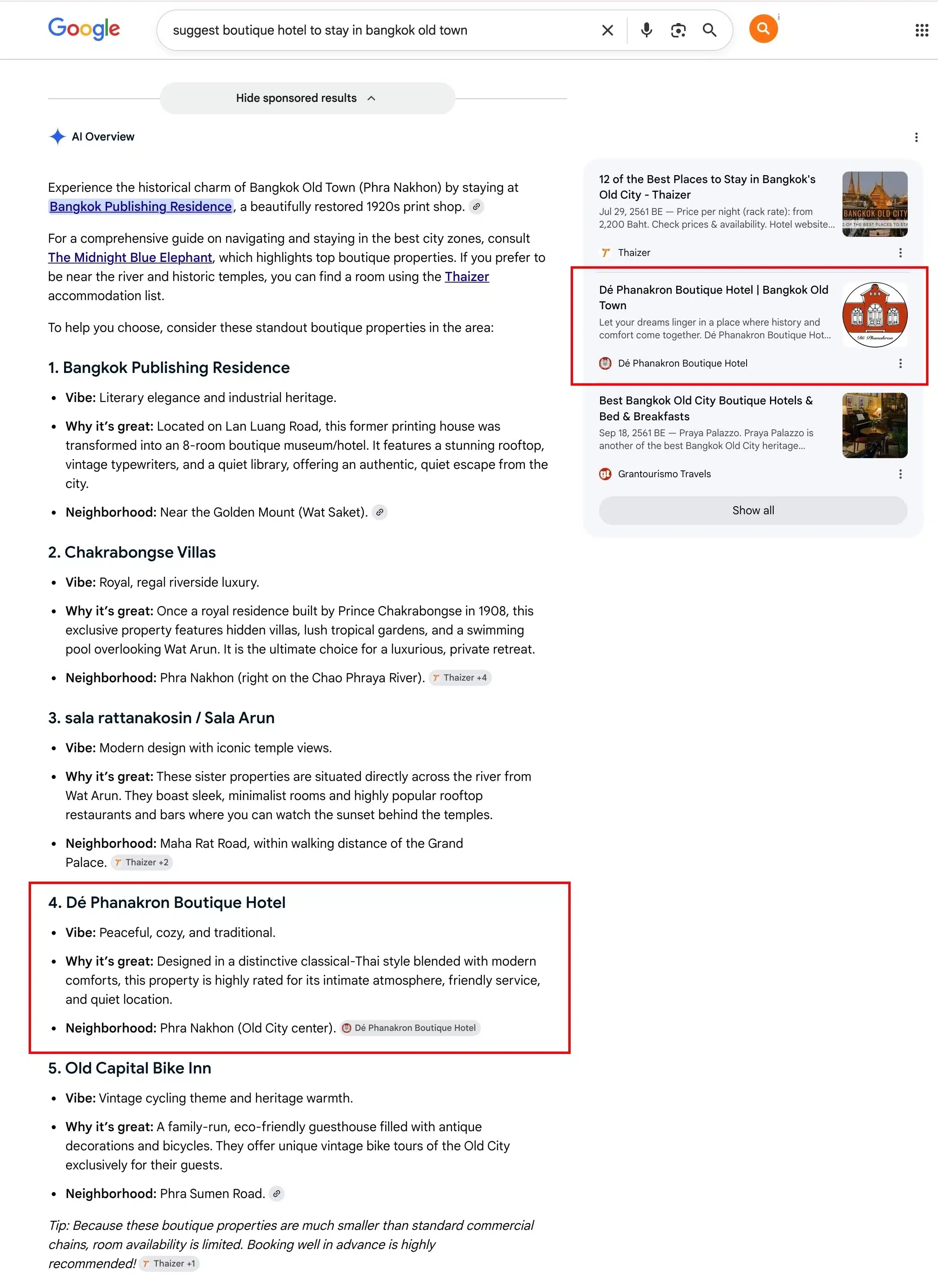
GEO is the practice of optimizing your digital presence so that AI-powered search engines, such as ChatGPT, Google AI Overviews, Perplexity, and Gemini, confidently recommend your hotel or restaurant when travelers ask planning questions.
The simplest way to understand it:
“Traditional SEO was about ranking on a results page. GEO is about becoming part of the answer itself.”
Consider the difference. A traditional search returns a list of links. An AI search engine returns a direct recommendation: “For a romantic rooftop dinner in Bangkok, consider [Your Restaurant] known for its sunset views, Thai-French fusion menu, and attentive service.” That sentence, generated by AI and presented directly to your future guest, is GEO working for you.
For hotels and restaurants in Bangkok and across Thailand, this shift represents an extraordinary opportunity. Competition for AI recommendations in the hospitality niche is still relatively low, early movers can claim dominant visibility before the space becomes saturated.
Why Traditional SEO Is No Longer Enough
Traditional SEO still matters, do not abandon it. But in 2026, it is no longer sufficient on its own.
AI search engines do not browse page rankings the way Google does. They pull from structured data, trusted sources, review platforms, schema markup, and the clarity of your website content. A hotel that ranks third on Google might not appear in a single AI-generated recommendation if its website content is vague, its Google Business Profile is incomplete, or its reviews fail to tell a compelling and accurate story.
Travelers are also searching very differently than they did even two years ago. Instead of short keyword phrases like “Bangkok hotel,” they are now asking full questions: “What is the best boutique hotel in Bangkok for a honeymoon with a rooftop pool and easy BTS access?” AI engines answer these in seconds, but only cite properties whose digital presence is set up to provide that exact answer.
5 GEO Strategies for Hotels and Restaurants in 2026

1. Optimize Your Google Business Profile
Your Google Business Profile (GBP) is one of the most important data sources AI engines draw from when generating recommendations. An incomplete or outdated GBP dramatically reduces your chances of being cited by any AI tool.
At a minimum, your profile should include:
- Your full address, contact information, and accurate business hours (including public holidays)
- A compelling, keyword-rich business description
- High-quality photos updated regularly
- Prompt responses to recent guest reviews
- All relevant amenities and features clearly listed
For restaurants, also list your cuisine type, price range, whether you offer reservations or delivery, and any unique features such as rooftop seating, live music, or private dining rooms. AI engines prioritize businesses with rich, complete, and regularly updated profiles.
2. Structure Your Website Content for AI Parsing
AI engines “read” your website differently from a human visitor. They look for clearly structured, factual content that answers specific questions. Pages using headings, FAQ sections, bullet points, and tables are significantly easier for AI to parse and cite.
For hotels, create dedicated pages for each room type, amenity, and guest experience you offer, with rich, descriptive language. Do not just say “Superior Room.” Say “Superior Room with pool view, blackout curtains, king-size bed, and complimentary minibar, ideal for couples or business travelers on extended stays.”
For restaurants, describe your dishes, ingredients, and atmosphere in detail. Include FAQ-style content addressing questions like “Is the menu suitable for vegetarians?” or “Do you accept walk-ins for dinner?” These are precisely the types of questions AI tools are asked on behalf of travelers every day.
3. Add Schema Markup to Your Website
Schema markup is structured code added to your website that helps search engines and AI tools understand your business in precise, unambiguous detail. For hotels, relevant schema types include Hotel, Local Business, Review, and FAQ schema. For restaurants, add Restaurant schema with cuisine type, menu links, price range, and reservation options.
While it may sound technical, schema markup is one of the highest-ROI changes you can make to your website. Properties with properly implemented schema see significantly higher AI citation rates, simply because the data is structured in a way that is easy for machines to process and trust.
4. Build Your Review Authority
AI engines do not just recommend businesses, they recommend highly-rated, well-reviewed businesses. Reviews are a core data source for AI-generated answers, and the volume, recency, and quality of your reviews directly influence whether your property gets cited.
A practical approach: after every guest checkout or dining experience, send a follow-up message with a direct link to your Google or TripAdvisor review page. Keep it simple and frictionless, and your review count will grow consistently over time.
How you respond to reviews matters just as much as the reviews themselves. Hotels and restaurants that actively reply to both positive and critical reviews signal to AI systems, and to prospective guests, that they are credible, engaged, and trustworthy. Aim to respond to every review within 48 hours.
5. Publish Intent-Driven Blog Content Consistently
One of the most powerful long-term GEO strategies is publishing content that directly answers the questions your future guests are already asking. This is called intent-driven content, and it is highly valuable for AI visibility.
Consider the questions travelers ask before visiting Bangkok: “What is the best area to stay in Bangkok for nightlife?” “Where should I eat near the Sukhumvit area?” “Which Bangkok hotels have a rooftop pool?” If your website answers these questions clearly and authoritatively, you become a credible source that AI engines will surface in their responses.
Every blog article you publish is another opportunity to answer a specific traveller question, and to position your property as the trusted answer. Publishing two to four well-optimized posts per month can significantly expand your GEO footprint over time.
The Future Belongs to Brands That Get Found First
The hospitality landscape in 2026 is being fundamentally reshaped by AI. Travelers are planning trips differently, discovering properties through new channels, and increasingly trusting AI-generated recommendations over traditional search results. The brands that will thrive over the next decade are not necessarily the ones with the most luxurious rooms or the most creative menus, they are the ones that are visible when and where their guests are searching.
GEO is not a replacement for great hospitality. It is the strategy that ensures the right guests find you before they even set foot in Bangkok. And the best time to start building that visibility is right now, before your competitors do.
At BFound Digital, we specialize in helping hotels and restaurants build the kind of digital presence that gets noticed, by search engines, AI tools, and the guests who matter most. Whether you are starting from scratch or looking to elevate an existing strategy, we are here to help you grow. Follow us for tips, insights, and strategies that actually work.
🌐 Website: bfound-digital.com
📘 Facebook: BFound Digital
📸 Instagram: @bfounddigital
▶️ YouTube: BFound Digital
💼 LinkedIn: BFound Digital
🎵 TikTok: @bfounddigital